The Maintenance Mirage
How "Run-to-Failure" Policies Quietly Castrate Your Cash Flow
Walk into almost any mid-market manufacturing plant, and you will eventually encounter a deeply entrenched operational philosophy: "If it ain't broke, don't fix it."
To a boardroom staring at a tight monthly budget, delaying scheduled asset maintenance feels like an easy win for cash preservation. Deferring a service interval or skipping a component replacement keeps immediate maintenance expenditures low, making the short-term ledger look pristine.
But as a Cost Architect, I recognize this approach for what it truly is: The Maintenance Mirage.
Treating asset health as an optional, negotiable expense is a mathematical trap. When you run industrial machinery to the point of structural failure, you aren't saving capital—you are simply taking out a high-interest operational loan that your margins will eventually have to pay back at a premium.
The Forensic Ledger of Reactive Maintenance
The fundamental flaw in standard cost accounting is that it isolates maintenance costs into a single, neat bucket. The spreadsheet shows the cost of the replacement part and the mechanic's hours, but it completely fails to capture the systemic collateral damage.
When a critical asset experiences an unplanned breakdown, the true economic penalty compounds across five distinct operational layers:
Machine Downtime Debt: The line freezes. Unplanned downtime halts throughput velocity, instantly creating an operational bottleneck that makes meeting committed customer delivery dates physically impossible.
Emergency Procurement Premiums: To get the asset back online, management is forced into panic-buying. Standard shipping is replaced by expensive overnight airfreight, inflating parts costs by 300% to 400%.
Unscheduled Overtime Tax: Repairing a catastrophic failure during peak production requires emergency, round-the-clock technician shifts, forcing you to pay premium overtime wages for non-value-adding recovery work.
Collateral Component Destruction: Mechanical systems are deeply interdependent. A simple, neglected bearing failure rarely stays isolated; it quickly degrades shafts, burns out motors, and compromises seals. What could have been a $50 preventative fix mutates into a $20,000 system rebuild.
Safety and Regulatory Penalties: Sudden catastrophic failures do not just stop production—they trigger severe worker safety hazards, environmental leaks, and compliance violations that carry heavy statutory fines.
Case Study: The 2.5 Million Rupee Gearbox Penalty
The real-world cost of this mirage is perfectly illustrated by a mid-market textile mill operating 120 high-velocity weaving machines. Seeking to cut immediate operational overhead, management adopted a strict "run-to-failure" policy and entirely stopped stocking "unnecessary" mechanical spares.
During a peak international export season, the gearbox of a primary bottleneck loom shattered. Because the asset had been run past its engineering tolerances, the failure was catastrophic.
The financial fallout was immediate:
The Downstream Domino Effect: The failed loom acted as the primary anchor for the facility. When it died, 15 downstream machines were completely starved of inputs and forced into a mandatory standby state.
The 10-Day Cash Freeze: Because management had skimped on local inventory spares to save cash, production ground to a halt for 10 days while replacement components were air-freighted across international borders.
The Ultimate P&L Hit: The air freight and emergency repair labor cost multiple times the value of standard preventative care. Worse, the delayed shipment triggered severe contract penalties amounting to ₹2.5 million, alongside a devastating loss of reputation among international buyers.
A simple, scheduled inspection could have identified the micro-wear on that gearbox weeks in advance, protecting the mill’s global liquidity for a fraction of the cost.
Navigating the 4 Levels of Asset Stewardship
To protect your margins from unexpected operational shocks, you must graduate from reactive chaos and understand the four distinct categories of plant maintenance:
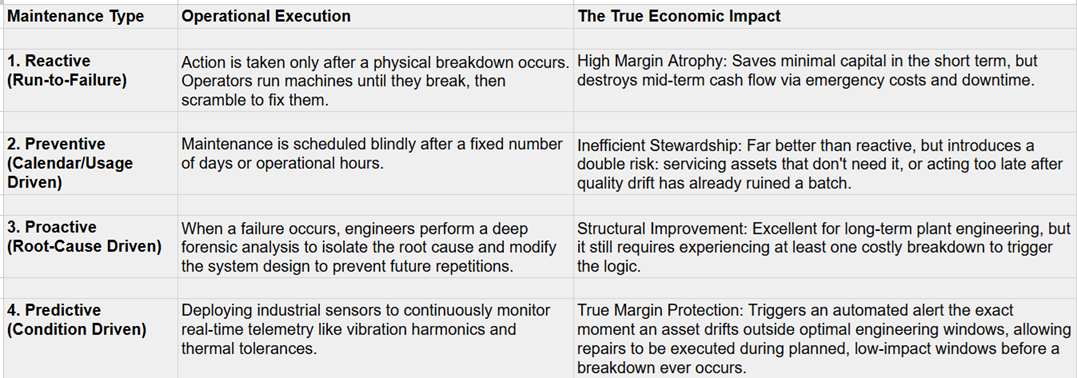
The Cost Architect's Verdict
Delaying or eliminating routine asset maintenance is a classic symptom of boardroom short-sightedness. Industrial machinery is subject to the unyielding laws of physics; components will wear down. The only question is whether you choose to pay for that wear during a scheduled, controlled, low-impact maintenance window, or let an unexpected breakdown dictate your P&L performance.
In the modern manufacturing landscape, where margins are razor-thin and delivery commitments are absolute, running a plant without predictive telemetry is no longer a viable cost-control strategy. It is simply an operational gamble.
Stop treating asset health as an administrative expense. Tighten your maintenance loops, eliminate uncalibrated asset drift, and secure your structural cash flow from the shop floor up.